


Page 1663 - MiSUMi 2025
P. 1663
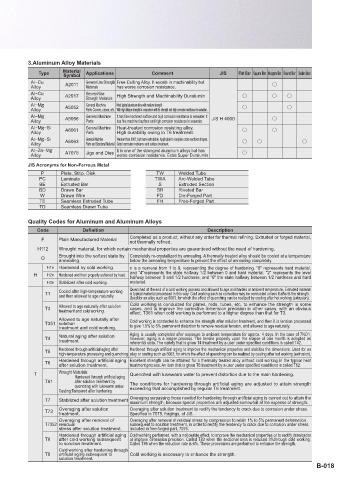
3.Aluminum Alloy Materials
                    Type    Material   Applications   Comment              JIS   Flat Bar Square Bar Hexagonal Bar Round Bar Section Steel
                            Symbol
                  Al−Cu     A2011  General-Use Strength  Free-Cutting Alloy. It excels in machinability but   k
                  Alloy           Materials  has worse corrosion resistance.
                  Al−Cu     A2017  General-Use   High Strength and Machinability Duralumin
                  Alloy           Strength Materials                              k        k    k
                  Al−M            General Machine  Most typical aluminum alloy with medium strength.
                  Alloy     A5052  Parts Covers, cases, etc. With high fatigue strength in comparison with its strength and high corrosion resistance to seawater.   k  k
                  Al−M      A5056  General Machine   It has fine machined surface and high corrosion resistance to seawater. It   JIS H 4000  k
                  Alloy           Parts     has fine machined surface and high corrosion resistance to seawater.
                  Al−M −Si  A6061  General Machine   Heat-treated corrosion resisting alloy.
                  Alloy           Parts     High durability owing to T6 treatment.  k      k
                  Al−M −Si        General Machine  Weaker than 6061, but more extrudable. Applicable to complex cross-sections shapes.
                  Alloy     A6063  Parts and Structural Material Good corrosion resistance and surface treatment.   k  k  k
                  Al−Zn−M                   It is one of the strongest aluminum alloys but has
                  Alloy     A7075  Jigs and Dies  worse corrosion resistance. Extra Super Duralumin  k
                 JIS Acronyms for Non-Ferrous Metal
                     P     Plate, Strip, Disk           TW     Welded Tube
                    PC     Laminate                    TWA     Arc-Welded Tube
                    BE     Extruded Bar                 S      Extruded Section
                    BD     Drawn Bar                    BR     Riveted Bar
                     W     Drawn Wire                   FD     Die-Forged Part
                    TE     Seamless Extruded Tube       FH     Free-Forged Part
                    TD     Seamless Drawn Tube

                 Quality Codes for Aluminum and Aluminum Alloys
                    Code         Definition                            Description
                     F    Plain Manufactured Material  Completed as a product, without any order for thermal refining. Extruded or forged material,
                                                not thermally refined.
                    H112  Wrought material, for which certain mechanical properties are guaranteed without the need of hardening.
                          Brought into the softest state by  Completely re-crystallized by annealing. A thermally treated alloy should be cooled at a temperature
                     O    annealing.            below the annealing temperature to prevent the effect of annealing completely.
                       H1n  Hardened by cold working.  n is a numeral from 1 to 9, representing the degree of hardening. "8" represents hard material,
                   H   H2n  Hardened and then properly softened by heat.  and "4"represents the state halfway 1/2 between 0 and hard material. "2" represents the level
                                                halfway between 0 and 1/2 hardness, and "6" the state halfway between 1/2 hardness and hard
                       H3n  Stabilized after cold working.  material.
                                                is typical material processed in this way. Cold working such as correction may be conducted unless it affects the strength.
                      T1  Cooled after high-temperature working  Quenched at the end of a cold working process and allowed to age and harden at ambient temperature. Extruded material
                          and then allowed to age naturally.
                                                Used for an alloy such as 6063, for which the effect of quenching can be realized by cooling after hot working (extrusion).
                      T3  Allowed to age naturally after solution   Cold working is conducted for plates, rods, tubes, etc. to enhance the strength in some
                                                cases, and to improve the corrective dimension precision in other cases, with an obvious
                          treatment and cold working.  effect. T361 when cold working is performed to a higher degree than that for T3.
                          Allowed to age naturally after   Cold working is conducted to enhance the strength after solution treatment, and then it is tension processed
                      T351 solution             to give 1.5% to 3% permanent distortion to remove residual tension, and allowed to age naturally.
                          treatment and cold working.
                      T4  Natural aging after solution   Aging is usually completed after exposure to ambient temperature for approx. 4 days. In the case of 7NO1,
                                                however, aging is a longer process. The tensile property upon the elapse of one month is adopted as
                          treatment
                                                referential data. The variety that is given T4 treatment by a user under specified conditions is called T42.
                      T5  Hardened through artificial aging after   Hardened through artificial aging to improve the mechanical properties and stabilize the dimensions. Used for an
                          high-temperature processing and quenching alloy or casting such as 6063, for which the effect of quenching can be realized by cooling after hot working (extrusion).
                      T6  Hardened through artificial aging  Excellent strength can be attained for a thermally treated alloy without cold working in the typical heat
                                                treatment process. An item that is given T6 treatment by a user under specified conditions is called T62.
                          after solution treatment.
                   T      Wrought Materials:    Quenched with lukewarm water to prevent distortion due to the main hardening.
                               Hardened through artificial aging

                      T61      after solution treatment by  The conditions for hardening through artificial aging are adjusted to attain strength
                               quenching with lukewarm water.  exceeding that accomplished by regular T6 treatment.
                          Casting:Tempered after hardening
                      T7  Stabilized after solution treatment  Overaging surpassing those needed for hardening through artificial aging is carried out to attain the
                                                maximum strength, because special properties are adjusted somewhat at the expense of strength.
                      T73  Overaging after solution   Overaging after solution treatment to rectify the tendency to crack due to corrosion under stress.
                          treatment.            Specified in 7075, forgings, of JIS.
                          Overaging after removal of   Overaging after removal of residual stress by compression to retain 1% to 5% permanent deformation
                      T7352 residual            subsequent to solution treatment, in order to rectify the tendency to crack due to corrosion under stress.
                          stress after solution treatment.  Included in free-forged part, 7075.
                          Hardened through artificial aging  Cold working performed, with a noticeable effect, to improve the mechanical properties or to rectify drawbacks
                      T8  after cold working subsequent   or improve dimension precision. Called T83 when the sectional area is reduced 3%through cold working.
                          to solution treatment.  Called T86 when the reduction rate is 6%. These procedures are performed to enhance the strength.
                          Cold working after hardening through
                      T9  artificial aging subsequent to   Cold working is necessary to enhance the strength.
                          solution treatment.
                                                                                                        B-018

